St. Petersburg's 49% Rule: Remodel, Repair or Rebuild After Helene and Milton
St. Pete counts 49%, not FEMA's 50%. How the City figures it, what crossing it forces, and when a new elevated home beats a big remodel.

Partner, Head of Digital Transformation & Operations · November 16, 2026 · 8 min read
What the 49% rule is
FEMA's flood insurance program lets cities keep insuring older homes built below today's flood elevations, as long as those homes are not substantially improved or substantially damaged. FEMA sets the line at 50% of the building's market value. St. Petersburg sets it at 49%. The City's code: "Substantial improvement means any repair, reconstruction, rehabilitation, alteration, addition, or other improvement or modification of a building or structure, the cost of which equals or exceeds 49 percent of the market value of the building or structure before the start of construction of the improvement, alteration or repair."
The same 49% line applies in two situations:
- Substantial damage: the cost to restore the house to its condition before a storm (or a fire, or any other cause) reaches 49% of its value before the damage. The damage doesn't have to come from a flood.
- Substantial improvement: a remodel, an addition or any other improvement costs 49% or more of the value before the work starts. No storm is needed; a large voluntary remodel counts too.
Once a house is found substantially damaged, the code counts every repair to it as a substantial improvement, "regardless of the actual repair work performed."
The rule applies to buildings in the special flood hazard areas on FEMA's maps (zones that start with A or V). Much of the waterfront and many older neighborhoods of St. Pete are in them; FEMA's Flood Map Service Center shows your lot. If a house already meets today's flood rules, crossing the line asks little more of it.
The City enforces the rule closely for a reason. Its storm page says that without it, the whole city risks losing the 25% discount on National Flood Insurance Program premiums that every resident gets today.
How the City counts it
Two numbers make the test: the cost of the work, and the value of the building.
The value is the building only, never the land or the other improvements on the lot. The code calls it the building's actual cash value: what it would cost to replace in kind, less age, wear and tear. The City takes it from the Pinellas County Property Appraiser's value for the building, adjusted by a factor the Appraiser provides. If you think that is too low, you can hand in your own appraisal by a Florida state-licensed appraiser, made within the last 12 months. After a storm, the value is the one before the damage.
The cost is the full market cost of the work: materials, labor, supervision, insurance, demolition, and the contractor's overhead and profit. Work you or friends do for free, and materials you get free or at a discount, are counted at what they would normally cost. Once the work is estimated at more than 25% of the value, the City asks for a detailed estimate of the whole job. It can also check that estimate against the International Code Council's published construction cost per square foot, and the code counts the higher of the two unless the City decides otherwise.
The City doesn't add up separate projects over the years: its code says the costs "shall not be cumulative from project to project", and since June 26, 2025 Florida law has barred cities from adding up work over a period of years. But earlier permits have to be closed out first, or their value is added to the new one.
What counts and what doesn't
| Counted toward the 49% | Not counted |
|---|---|
| Foundations, slabs, walls, framing and roof trusses | Plans, specifications and surveys |
| Roofing, windows, exterior doors, stucco, attached decks and porches | Permit and inspection fees |
| Drywall, flooring, tile, interior doors, trim and insulation | Clean-up and trash removal after a storm |
| Built-in cabinets and appliances, bathroom fixtures | Carpet laid over finished flooring |
| Plumbing, electrical, lighting, air conditioning, security systems | Plug-in appliances such as a washer, dryer or stove |
| Demolition and hauling away construction debris | Landscaping, driveways, fences, pools, detached garages and sheds |
| Supervision, overhead and profit, sales tax on materials | Temporary work to make a damaged house safe to enter |
| Work another code requires because of the project | The minimum work to fix documented health, safety or sanitary code violations |
The table follows FEMA's Substantial Improvement/Substantial Damage Desk Reference (FEMA P-758): what counts is what is "directly associated with the building." The City's code adds that the costs "shall include all costs attributed to a project."
An example
A made-up example, to show the arithmetic. A 1950s block house on a canal lot. The Property Appraiser's value for the building (not the land), after the Appraiser's factor, is $180,000. 49% of that is $88,200.
- The owners plan a new kitchen ($55,000), two new bathrooms ($38,000) and impact windows ($28,000): $121,000.
- That is 67% of $180,000, over the line: the house would have to be raised to today's flood height.
- An appraisal at $230,000 would move the line to $112,700. Still over.
- Cutting the job to the kitchen and windows ($83,000) stays under the line. The bathrooms could follow later as a separate project, once the first permit is closed out.
What crossing the line means
Once the work reaches 49%, the whole house has to meet the flood rules for new construction, not just the part you are working on. The City's page puts it plainly: you "will be required to bring the structure into compliance with current zoning, building, and floodplain management requirements." For the flood part, that means:
- The lowest floor raised to the required height: in St. Petersburg, 2 feet above the base flood elevation on FEMA's map, or the design flood elevation if that is higher. In V zones and Coastal A zones, it is the bottom of the lowest beam under the floor that has to reach that height.
- Below that floor, only parking, building access and storage: no finished rooms and no air conditioning, built with flood-resistant materials, and with flood vents in the walls of any enclosed space.
- Air conditioning, electrical panels, water heaters, ducts and other equipment at or above the required height.
Raising an existing house is possible, but many older St. Pete homes sit on a concrete slab on the ground, the hardest kind of house to lift. The cost of lifting it, a new foundation, new stairs and new utilities on top of the remodel itself often comes close to the cost of a new house.
Your options
- Stay under the line. Plan the work so it stays below 49%. Ask the City how it will count work done over several permits before you split a project.
- Check the value. If the Property Appraiser's building value looks low, a recent appraisal by a state-licensed appraiser can raise the line.
- Raise the existing house. Usually best for homes on piers or crawl spaces, rarely for a house on a slab.
- Build new. Take the house down and build to today's flood, wind and energy codes.
- Use your flood policy. If the house carries flood insurance and the City finds it substantially damaged by a flood, the policy's Increased Cost of Compliance coverage pays up to $30,000 toward raising, moving, floodproofing or demolishing it.
- Grants, if you qualify. The City's Sunrise St. Pete program has grants to repair, rebuild or elevate homes damaged by Hurricanes Idalia and Helene, for owners within its income limits; its applications are paused as of this writing. Pinellas County's reconstruction program does not take homes inside the City of St. Petersburg.
When a new home makes more sense
In our experience the answer usually comes down to three things: how far the floor is below the required height, how much of the house you want to change anyway, and what the lot is worth. When the floor is several feet low, the house is on a slab and the plans go past a kitchen and a bathroom, a new elevated home is often the better use of the money. It also comes with a new roof, impact glass, new systems and a lower flood insurance rate, and it sells as a new home.
For what a new home costs and what goes into the price, see our post on what it costs to build a custom home in St. Petersburg.
When the house is close to the required height, or the work is modest, repairing or remodeling under the line is usually the right call.
How we help
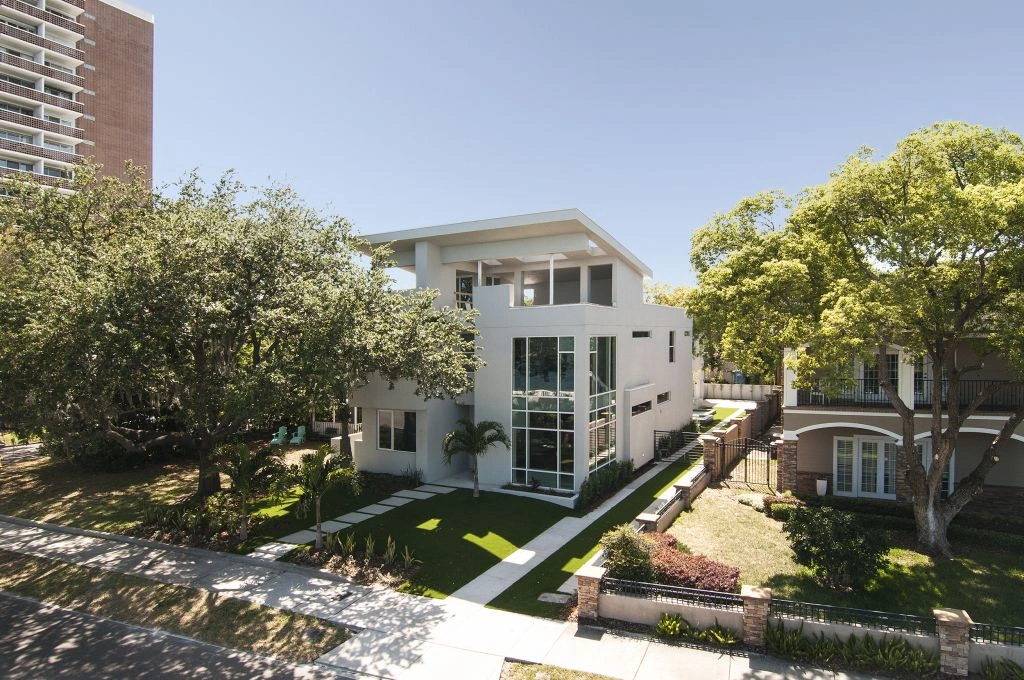
Before anyone draws anything, we look up the building's value, the flood zone and the required height for the lot, and we price both roads: the remodel under the line, and a new home. You see the numbers side by side before you decide. The City makes the call on each house; its storm permitting desk answers questions at StormRecoveryPermits@stpete.org or 727-893-7231.
If you own a home in St. Petersburg and you're weighing a remodel or a rebuild, book a consultation and bring your address.
Questions and answers
Does the 49% rule apply if my house was not damaged?
Yes. A large voluntary remodel or addition is a substantial improvement once it costs 49% of the building's value.
Does it apply outside a flood zone?
No. It applies to buildings in FEMA's special flood hazard areas (zones starting with A or V). Inside them, the City's page says it applies to all repairs, even when the damage wasn't caused by flooding.
Is the land value included?
No. Only the building's value counts, from the Property Appraiser or your own appraisal from the last 12 months.
Is it 49% or 50%?
FEMA's national minimum is 50%. St. Petersburg uses 49%.
Can I split the work into phases to stay under?
Only as truly separate projects. The City doesn't add up separate projects over the years, but any earlier permit has to be closed out first, or its value counts toward the new one. Ask the City before you split one plan into stages.
Does the rule apply to a historic home?
The City's code leaves out alterations of a designated historic building, as long as the work doesn't cost the building its historic designation. Talk to the City before you count on it.
What if my house is already high enough?
If the house already meets today's flood rules, the 49% line asks little more of it. Your elevation certificate shows how high the lowest floor is.
Sources: City of St. Petersburg, The 49% Rule (permitting after a storm), read October 29, 2026; City Code sec. 16.40.050, floodplain management (16.40.050.3.4 and 16.40.050.9.4 definitions), Supplement 55 Update 2, read October 29, 2026; City Code sec. 8-36, amendments to the Florida Building Code (R322.2.1 and R322.3.2, freeboard), read October 29, 2026; Florida Building Code, Residential, 8th edition (2023), R322.1.6 and R322.2.2, read October 29, 2026; Florida Statutes 163.31795 (chapter 2025-190, SB 180, in force June 26, 2025): no cumulative substantial improvement periods, read October 29, 2026; FEMA P-758, Substantial Improvement/Substantial Damage Desk Reference, sections 4.4.1 and 4.4.2, read October 29, 2026; FEMA, Increased Cost of Compliance coverage, read October 29, 2026; City of St. Petersburg, Sunrise St. Pete recovery grants, read October 29, 2026; Pinellas County, Homeowner Rehabilitation/Reconstruction Program (eligibility), read October 29, 2026; FEMA Flood Map Service Center (look up a lot's flood zone)